Siai Marchetti Sf260 3view Plans Drawings Bleuprints
| SF.260 | |
|---|---|
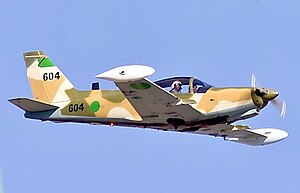 | |
| A SF.260 of the Libyan Air Strength | |
| Function | Trainer/Light attack |
| Manufacturer | SIAI-Marchetti Aermacchi Alenia Aermacchi Leonardo S.p.A. |
| Designer | Stelio Frati |
| First flight | 15 July 1964 |
| Introduction | April 1966 (FAA certification)[ane] |
| Condition | In service |
| Primary users | Italian Air Force Libyan Air Force Philippine Air Force Belgian Air Forcefulness |
| Produced | 1964–2017 |
| Number congenital | 870+ (2005)[2] |
The SIAI-Marchetti SF.260 (now Leonardo SF-260)[3] is an Italian light shipping which has been commonly marketed equally a military trainer and aerobatics aircraft.
The SF.260 was designed by Italian shipping designer Stelio Frati, while production work originally performed by Milan-based aviation manufacturer Aviamilano. On fifteen July 1964, the get-go prototype performed its maiden flight (then designated F.260). Shortly thereafter, responsibility for production was transferred to SIAI Marchetti, who had purchased the rights to the design; manufacturing connected to exist performed by this house until the company was bought by Aermacchi in 1997.
The SF.260 has been largely sold to military customers as a trainer and lite combat shipping. In addition, there accept been limited civil sales to individual operators; during the belatedly 1960s, the type was marketed in the United states under the name Waco Falling star. Armed war machine versions, sold as the SF.260W Warrior, proved to be pop with smaller air forces, which could arm the type for use in the shut air back up role. Both piston-powered and turboprop-powered models take been developed.
Evolution [edit]
Origins [edit]
During the early 1960s, Italian shipping designer Stelio Frati commenced work upon a new three-seat aerobatic pattern, which was primarily intended to serve as a sport aircraft.[4] Unlike many of its peers of the era, information technology was developed to possess aerobatic capabilities akin to contemporary combat shipping, too equally being equipped for musical instrument flying rules (IFR) flight.[5] This design drew heavily upon his previous projects, including the jet-powered Caproni Trento F-5 image trainer and the Sequoia Falco twin-seat aerobatic shipping, sharing the same wing and a similar structure to the Falco.[6] The envisioned aircraft, initially designated as the F.250 due to the horsepower of its engine, was Frati's first all-metallic shipping.[6]
On 15 July 1964, the blazon performed its maiden flight.[6] In the aftermath of the maiden flight, prime responsibility for the type's industry was acquired from Aviamilano by SIAI Marchetti, which had purchased the rights to the pattern outright. Shortly afterward inbound production, the SF.260 constitute itself in high demand by armed forces customers, who oftentimes adopted it interchangeably equally a military trainer or as a lightweight ground-assail shipping.[5] Between 1964 and 1984, the majority of customers for the blazon were war machine, while a small number of individual pilots had been able to obtain a few, although supply in this respect was constrained.[5]
During the late 1960s, the aircraft was marketed in the U.s.a. market place as the Waco Meteor, although it had no connections of whatever course with the Waco Shipping Visitor; the venture was relatively unsuccessful.[vii] During the tardily 1970s and 1980s, American airline pilot Frank Strickler became a major reseller of the type, beingness credited with re-launching ceremonious sales of the SF.260 in the region, acquiring them from SIAI Marchetti in small batches and individually selling them on to United states of america-based customers.[5]
Further development [edit]
During the late 1970s, an improved model of the SF.260A, designated as the SF.260C, had replaced it in product.[eight] This model featured various improvements, including redesigned tabs on the ailerons, a strengthened fly, a re-profiled aerofoil for improved depression-speed handling, and an elongated tail/rudder. The SF.260C was designed for compliance with the requirements of armed services specifications.[8] The only structural difference between the SF.260C and its armed brethren, the SF.260W Warrior and SF.260SW Body of water Warrior, is the presence of underwing hardpoints for attaching equipment and armaments.[eight]
During 1980, SIAI Marchetti performed the first flying of a turboprop-powered SF.260TP, powered by an Allison Model 250 engine flat-rated at 350 shp.[9] This variant was marketed towards the military trainer market, which presently adopted the blazon. In August 1986, Gates Learjet was approached by SIAI Marchetti to modify the SF.260TP for it to exist compliant with the requirements of Federal Aviation Administration's (FAA) FAR Part 23, thus assuasive it to be certified for civil use.[10] Modifications were made in order to attain lower stall speed and greater payload capacity, these functioning improvements were principally achieved through aerodynamic alterations, such as the adoption of 'shark's teeth' forth the fly'southward leading edge.[11]
During 2005, a batch of 30 SF.260EA were delivered to the Italian Air Force for a full price of €33 1000000 ($40 one thousand thousand).[2] This model, which had been specially developed to run into an Italian Air Force requirement for an advanced piston-engine aircraft, is used for screening and master training activities.[2]
Design [edit]

The SIAI-Marchetti SF.260 is a depression-mounted cantilever wing monoplane, complete with a retractable tricycle undercarriage. It has been often praised for its sleek lines and sporty aesthetic appearance, while maintaining function every bit well, possessing jet-similar handling as a event.[7] The construction is typically known for having a loftier level of workmanship, while exterior is extensively affluent-riveted to reduce aerodynamic drag, except for a few locations such equally the flaps and some fairings.[12] The SF.260 has a meaty, dense construction which possesses ballistics like to a jet shipping, and is canonical to perform aerobatic manoeuvres.[1] In comparison to nigh single-engine aircraft, it possesses superior ability loading and above average wing loading.[five]
The original model of the SF.260 was powered past a single Lycoming O-540 engine, capable of providing 260 hp.[5] The standard engine made use of a carburetor, while a fuel injected engine was available as an optional extra.[8] The SF.260 has been described every bit having the power to be immune to the gyration-like effects of turbulence and possessing a high rate of climb. During the 1980s, aerospace publication Flying Magazine stated the SF.260 to be: "the fastest normally aspirated piston single in production".[5] The SF.260 holds the airspeed records for aircraft in its course over the 100 km (62 mi) and one,000 km (620 mi) closed circuits.[ commendation needed ] Afterwards-built models often made use of turboprop engines; the initial model to be equipped every bit such, designated as the SF.260TP, was powered past a single Allison Model 250 engine, flat-rated at 350 shp.[nine]
The airplane pilot and upwards to two passengers (or airplane pilot and one student in trainer versions) are accommodated under a broad, extensively glazed awning.[1] The pilot, who accesses the aircraft via purpose-built walkways along the wing, would be typically seated on the right-hand side of the cockpit; military pilots are trained to control the aircraft using their right hand on the stick and their left on the throttle.[xiii]
While being a fully aerobatic aircraft, it possesses favourable handling qualities, including relatively tame stall characteristics. Controllability during stalls is augmented past vanes located on the wing tip tanks which accelerate airflow over the tips and ailerons.[8] The SF.260 is a relatively fast aircraft, complete with responsive controls; as a product of the latter, pilots need to maintain awareness of speed dips, although ample aerodynamic alert is typically present.[14] Piston-engined and turboprop-engined SF.260 models generally share similar treatment and flight operation.[xv] Speed limitations on the landing gear has been highlighted every bit a negative aspect.[16] In club to safely perform aerobatics, the rear seat has to be unoccupied and the tip tanks must exist empty of fuel prior to commencing any such manoeuvers, reducing the SF.260'southward flight endurance to roughly one and a half hours.[17]
Operational history [edit]
Burkina Faso [edit]
This small air force operated six Warriors with marks BF-8421 (c/north 049), BF-8424 (c/n 254), BF-8431 (c/north 116), BF-8451 (c/n 206), BF-8477 (c/due north 134) and BF-8479 (c/n 136);[18] these Warriors were sold from the Philippines via Kingdom of belgium in 1986, and were complemented by other iv new Warriors coming directly from Italian republic,[18] and employed during the Agacher Strip War with Republic of mali in 1986. These aircraft were in service with Escadrille de Chasse ("Fighter Squadron") in the Force Aérienne du Burkina Faso (FABF), the Burkina Faso Air Force.[18]
Chad [edit]
Chad informed the United nations that, during the conflict with Libya, information technology had destroyed 8 Libyan Air Force SF.260WLs and captured nine others, likewise destroying and capturing other equipment. Equally many every bit six former Libyan SF.260WLs may have been pressed into service with Chad's Air Forcefulness. Past 1988, four SF.260Ws were identified as existence in service, two of them were overhauled one year later in France.
In November 2006, Libya supplied Republic of chad with four SF.260W aircraft, including crew, due to tensions between Republic of chad and Sudan over the Darfur area. 1 newly supplied SF.260W was shot downwardly on 28 November – its first mission in Chad – by rebel forces, killing the crew.[nineteen]
Libya [edit]
Libya was a major customer of the SIAI Marchetti SF.260 with an order of 240 SF.260WLs. The starting time threescore aircraft were manufactured in Italy, while the others were delivered every bit knock-down kits, and assembled in a new plant in Sebha, under the supervision of Italian technicians.[20]

A formation of three Libyan SF.260s in flight, 2009
The SF.260WL was intended for pilot training, but was also used for ground back up during the state of war in Chad.[21] Dozens of Italian pilots served equally instructors for Libyan cadets from 1977 onwards. Their number decreased in 1982, as they were supplemented by a group of 15 Libyan instructors, who had been trained at SIAI Marchetti's facilities in Italy.[22] Libyan SF.260s played an important role during the land'due south involvement in Republic of chad. They were used as light ground attack aircraft, using machine gun pods, rockets and bombs.[23] Their first known actions took place in February 1978, when they participated in air strikes on the Chadian regular army garrison of Faya-Largeau together with Mil Mi-25 helicopters. As a outcome of the sustained bombardment, the majority of the 5,000 troops deployed there fled, and around 1,500 of them were taken prisoners on Feb 18.[24]
Gaddafi finally succeeded in installing a generally pro-Libyan government in North'Djamena in 1979 (the Transitional Government of National Unity or GUNT). Even so, the new Chadian defence government minister, Hissène Habré, was fiercely anti-Libyan, and immediately started distancing himself from the rest of the regime. This culminated in Habré's forces taking North'Djamena on 1 Apr 1980. Pro-Libyan factions fled to Great socialist people's libyan arab jamahiriya, where they were reorganized and re-armed.[25] These forces came back to Chad in Oct of the same year, together with the Islamic Legion. Once again, SF.260s were involved in heavy airstrikes on Faya-Largeau, together with Mi-25 helicopters, Mirage 5s and Tupolev Tu-22s. The quasi-continuous bombardment, which lasted for almost a week, had a big bear on on the morale of the defenders. Hence, the pro-Libyan GUNT forces easily took control of Faya-Largeau in early November 1980.[26]
After standing the accelerate towards the south, by tardily November, pro-Libyan units had reached Dougia, only lx kilometres northward of N'Djamena. Libyan SF.260s were frontward-deployed there, together with Mi-25s. On 8 December, these aircraft, joined on 12 December by Tu-22 bombers, D-xxx howitzers, and Chiliad-46 field guns, started attacking N'Djamena. The calendar week-long bombing caused a huge amount of destruction in the Chadian capital letter, and a number of noncombatant casualties that remains unknown today. After Habré fled to Cameroon, resistance collapsed and his surviving fighters escaped to Sudan.[26]
In August 1981, Gaddafi ordered the Libyan Arab Air Force to attack Habré's bases within Sudan.[27] On 16 September, a SF.260 was shot down by footing fire near Junaina in the Darfur region of Sudan; both crew members were killed.[28]
In May 1982, Habré'south forces came back to Chad from their Sudanese bases, and in June 1982 they expelled the GUNT from the capital N'Djamena. Once once again, its main Goukouni Oueddei had to flee to Libya with his remaining forces.[29] After some other Libyan/GUNT offensive in 1983, France launched Functioning Manta, resulting in a general stalemate that lasted until 1986; pro-Libyan GUNT forces retained control of the northern parts of the country.[xxx] In February of that year, a new attack was launched towards the south, supported past SF.260s and helicopters. All the same, this offensive collapsed after merely iv days.[31]
Libyan SF.260s were used in the last stage of the conflict in Chad, the Toyota War, which started in Dec 1986. In February 1987, SF.260s were involved in attacks against FANT columns agile in the area n of Faya-Largeau, using unguided rockets. Chadian MANPADS teams armed with FIM-43 Redeyes and 9K32 Strela-2s claimed to have shot downwards i LAAF SF.260 on 14 March almost Fada.[32] V days afterwards, when Chadian forces ambushed a Libyan armoured cavalcade, another SF.260 was shot down, either by Chadian-operated Redeyes or by FIM-92 Stingers operated past a French special forces squad from the 11e régiment parachutiste de choc.[33] Moreover, twelve SF.260s were lost when Chadian forces overran the airfield at Ouadi Doum on 21 March, including v captured intact.[34] In an endeavor to destroy as much of the captured equipment equally possible, the Libyans heavily bombed the airfield from the air until late Apr. SF.260s were involved in these attacks. On 29 March, an SF.260 was claimed shot down by Chadian MANPADS northward of Zouar.[35] Lastly, in 1988, as Chad and Great socialist people's libyan arab jamahiriya were negotiating a settlement for the conflict, pro-Libyan insurgents were infiltrated into Sudan, from where they started attacking garrisons inside Republic of chad. They were often supported by SF.260s, and one of these was shot down on 28 Nov, and its crew captured.[36]
The Libyan regime supported friendly countries with arms, and several SF.260Ws were handed over to air forces such as those of Burkina Faso, Burundi, Nicaragua, Uganda and possibly others. In 1987 Chad reported to the United Nations the destruction of 8 SF.260s and the capture of 9 others during its border war with Great socialist people's libyan arab jamahiriya; some of these secondhand Libyan aircraft may fifty-fifty have found their mode onto the US marketplace.[ citation needed ]
Alenia Aermacchi refurbished twelve SF.260 chief trainers for the Libyan Air Forcefulness; the work was performed jointly by Alenia Aermacchi and Tripoli-based Libyan-Italian Advanced Technology. The work included overhaul of the airframes and systems, including propellers and engines. Work began in late 2007 and ran through 2008.
During the civil war, on May 7, 2011, this aircraft (along with a formation of pro-Gaddaffi planes) was probably involved in a successful air raid over the rebel-held fuel depots at Misrata, setting them on burn down. NATO failed to intercept the flight, despite the introduction of a no-fly zone over Great socialist people's libyan arab jamahiriya in March. At the commencement of the uprising, one aircraft was crushed under a tank during a rebel assault on Misrata air base.[37]
Every bit of 2013, at least six airframes are yet in service with the new Libyan Air Force and are involved in patrols and perchance airstrikes against smugglers in the porous and remote borders.
Nicaragua [edit]
At to the lowest degree 7 SF.260WLs were received by the Fuerza Aérea Sandinista as support from Great socialist people's libyan arab jamahiriya in 1984-1985.[38] They may have been used in the Coin role confronting the Contras and in the pilot training office. No further details are known. Three SF.260s surfaced in the USA on the secondhand market place, a fourth is slowly existence rebuilt in Guatemala. No longer in service.
Philippines [edit]

A preserved Philippine SF.260
In the early 1970s, an gild was placed for 48 SF.260s (32 SF.260M; xvi SF.260W). The kickoff six were delivered in May 1973, replacing the Beech T-34A Mentor with 100th Grooming Wing at Fernando Air Base of operations.[39]
The 15th Strike Wing on airbase Sangley Point received the SF.260W Warrior as an addition to the Due north American T-28 Trojans. They were mayhap used in combat against rebel forces in the southward of the Philippines. But little is known nearly its service life. In the early 1980s, the surviving Warriors were disarmed and transferred to the training part with 100th Grooming Fly.[39]
The Philippines Air Forcefulness signed with Agusta a contract for the delivery of 18 SF.260TP turboprops on 31 Dec 1991, replacing the SF.260M/Westward in the training role. The first SF.260TP was noted in state on 1 July 1993.[39]
Under "Project Layang" the Philippines Air Force plans to upgrade 18 SF.260M/Westward shipping to the SF.260TP standard, past replacing the Lycoming piston engine with the Allison 250-B17D turboprop engine and newer avionics. The first upgraded SF.260 was delivered in 1996, no further details are available.[39] [40]
The Philippines has finalized a deal with Alenia Aermacchi for 18 new-build SF.260F primary/basic trainers. All 18 were delivered by Aermacchi Italy which was locally assembled by Aerotech Industries Philippines past April 2011.[41]
Six Warriors were sold to Burkina Faso via Belgium in 1986.[42]
Rhodesia [edit]
Despite an artillery embargo, two batches of SF.260 aircraft were delivered in 1977. Because of the embargo several ownership teams were travelling the globe looking for suitable equipment. Through various routes, 17 SF.260C and fourteen SF.260W aircraft arrived. The onetime to exist used in the training office, while the warriors were existence used for light set on duties and escort of convoys. In 1984–85 reportedly 8 SF.260Ws were converted to SF.260TP standard past replacing the piston engine with a turboprop engine.
Sri Lanka [edit]

Sri Lanka Air Force Museum SLAF SIAI-Marchetti on display
Six SF.260TPs were delivered to the Sri Lanka Air Strength (SLAF) in 1985, to be used in the pilot training office, although they were later brought into the authorities's effort to subdue the Tamil Tigers. Two former factory sit-in aircraft were delivered in 1986 to replace lost aircraft, added past three new built aircraft in 1988. All SF.260 aircraft are based with No. one Flight Training Fly on the airbase SLAF Anuradhapura. The SF.260TP fleet was expanded in 1990–91 with the delivery of twelve former Myanmar SF.260Ws. The SF.260W fleet was withdrawn from use in 2001, beingness replaced by Chinese Nanchang PT-6 aircraft. The SF.260TP fleet was also retired a few years subsequently.
Turkey [edit]
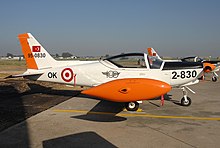
SF260D of Turkish Air Force at Izmir Air Base of operations.
In 1990, the Turkish Air Strength placed an order for twoscore planes. The first six were produced in Italian republic and the remaining 34 were produced past Turkish Aerospace Industries in Turkey, under licence. All of the planes are used in grooming and are deployed at the 123rd Basic Training Squadron stationed at İzmir.[43]
Zimbabwe [edit]
Information technology was appear at the 1997 Paris Salon that the Air Force of Republic of zimbabwe had ordered six F.260F aircraft, thus becoming the first operator of this new model. All six should take been delivered in 1998.[ citation needed ]
Variants [edit]
Aviamilano [edit]
- F.250 – first prototype powered by 187 kW (250 hp) Lycoming O-540-Help. The prototype, regn. I-ZUAR, was destroyed in a crash at Sestri Ponente, Genoa on seven November 1965.[44]
- F.260 – 2 prototypes powered by 194 kW (260 hp) Lycoming O-540-E4A5
SIAI Marchetti [edit]
- SF.260 – Production version of the F.260
- SF.260A – Initial production version. Built in small numbers.
- SF.260M – Militarised version with strengthened airframe and improved aerodynamics
- SF.260AM – Italian Air Force version, 33 built.
- SF.260ML – Export version for Libya, 240 congenital.
- SF.260W Warrior – Military version with weapons hardpoints
- SF.260SW Sea Warrior – Declension patrol, fishery protection aircraft. Ane built.
- SF.260B – Civilian version incorporating improvements of the SF.260M. Introduced 1974
- SF.260C – Improved version of the SF.260B; introduced in 1977.
- SF.260TP – Allison 250-B17D turboprop version of the SF.260C; first flown in 1980.
- SF.260D – SF.260C with uprated engine and other refinements. Introduced in 1985
- SF.260E – Uprated SF.260D to compete for a USAF contract just later marketed to other war machine buyers
- SF.260F – As above, with fuel-injected engine
- SF.260EA – Most contempo variant for Italian Air Force, thirty built.
Alenia Aermacchi [edit]
- SF-260 – current product model
Operators [edit]
Armed services operators [edit]

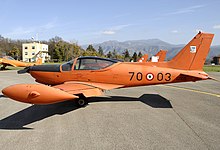
Italian Air Force SIAI-Marchetti SF260M

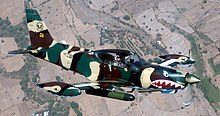
A SF-260 TP light attack aircraft used by the Philippine Air Force

Tunisian Air Force SF.260
-
 Belgium
- Belgian Air Component 36 SF-260M (1969) and nine SF-260D (1991).[45]
-
 Burkina Faso
- Burkina Faso Armed Forces, xix SF-260WL (ex Libya) and 3 SF-260W (ex Bolivia).[46]
-
 Burundi
- Republic of burundi Air Force, 3 SF260C (1981), 1 (9?) SF-260WL (ex Libya) and 4 SF-260TP.[46]
-
 Chad
Chad
- Chad Air Force, 9 SF-260WL (captured from Great socialist people's libyan arab jamahiriya).[47]
-
 Congo-kinshasa (from 1971 to 1997
  Zaire)
- Congo Air Strength, previously Zaire Air Force, 12 SF-260M (1971) and 9 SF-260MZ (1982)
-
 Ethiopia
- Ethiopian Air Force, x SF-250TP (1984) plus another 12 delivered in 1988[48]
-
 Indonesia
- Indonesian Air Force 19 SF-260M and SF.260W (2002, ex Singapore)[49]
-
 Italian republic
- Italian Air Force, 45 SF-260AM (1976-2005) and 30 SF-260EA (2004) [l] [51]
-
 Libya
Libya
- Libyan Air Force, 240 SF-260WL ordered in the mid-1970s.[xx]
-
 Mali
Mali
- Mali Air Force, 1 SF-260A (2018).
-
 Islamic republic of mauritania
- Mauritanian Air Force, 4 SF-260M (2018)[52]
-
 Mexico
- Mexican Air Forcefulness, 25 SF-260E (2019)[52]
-
 Philippines
- Philippine Air Force, 32 SF-260M and 16 SF-260W (1972 and 1974), eighteen SF-260TP (1991) and 18 SF-260FH (2008).[53]
-
 Tunisia
- Tunisian Air Strength, nine SF-260C and 12 SF-260W (1975)[54]
-
 Turkey
- Turkish Air Force, 40 SF-260D (1990).[54]
-
 Republic of uganda
- Ugandan Air Force, 2 SF-260WL (ex Libya) and 6 SF-260M[55]
-
 Uruguay
- Uruguayan Air Strength, xiii T-260EU (1999)[56]
-
 Venezuela
- Venezuela Air Strength 12 SF-260EU (2000)[56]
-
 Zambia
- Zambian Air Force 9 SF-260M (1971-1976) and nine SF-260TW (2018)[56]
-
 Zimbabwe
- Air Forcefulness of Zimbabwe, 6 SF.260F (1998)[56]
Quondam military operators [edit]
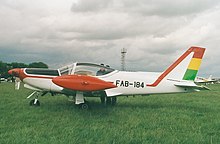
Bolivian Air Strength SF-260

Haitian Corps d'Aviation SF-260TP
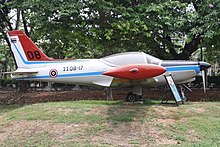
Royal Thai Air Force SF-260MT at Don Mueang International Airdrome
-
 Bolivia
- Bolivian Air Force, 6 SF-260W (1978-1987)
-
 Negara brunei darussalam
- Royal Brunei Air Force, 2 SF-260W (1982-1998)
-
 Comoros
- Comoros Police force Aviation, 17 SF-260C and 14 SF-260W (1977), actually re-routed to Rhodesia, plus 3 SF-260 (1978) probably never delivered.
-
 Republic of haiti
- Haitian Air Force, half dozen SF-260TP (1992)
-
 Ireland
- Irish Air Corps, 10 SF-260W (1977)
-
 Myanmar
- Myanmar Air Force, 10SF260M and xi SF-260W (1975-1990), office re-sold to Sri Lanka.
-
 Nicaragua
- Fuerza Aérea Sandinista, 4 to vi SF260Wl (ex Great socialist people's libyan arab jamahiriya)
-
 Rhodesia
- Rhodesian Air Force, 17 SF-260C and 14 SF-260W (1977)[57]
-
 Singapore
- Republic of Singapore Air Force – 14 SF.260Ms (1971) and 12 SF.260Ws (1979 and 1981). Office re-sold to Indonesia.[58]
-
 Somalia
- Somali Aeronautical Corps, 12 SF-260C (1979)
-
 Sri Lanka
- Sri Lanka Air Force, 11 SF-260TP (1985-2001) and 12 SF-260W (1991-1998, ex Myanmar)
-
 Thailand
- Imperial Thai Air Force, 18 SF-260M (1973-1999)
-
 United Arab Emirates (Abu Dhabi)
- United Arab Emirates Air Strength, one SF-260W (1975-1983) and 6 SF-260TP (1983)
Ceremonious operators [edit]
Out of about 860 SF-260s produced, effectually 180 have been sold to civil users. Most of these are in private easily, although at to the lowest degree four airlines, Alitalia, Sabena, Regal Air Maroc and British Midland Airways purchased the aircraft every bit a trainer for airliner pilots. Air Combat USA operates ix SF-260s.[59]
Specifications (SF-260M) [edit]
Data from Jane's all the World's Aircraft 1988–89[60]
General characteristics
- Coiffure: 2
- Capacity: 1 rider
- Length: 7.10 m (23 ft 4 in)
- Wingspan: 8.35 m (27 ft five in) over tip-tanks
- Height: 2.41 thou (7 ft 11 in)
- Wing expanse: ten.10 m2 (108.7 sq ft)
- Attribute ratio: half-dozen.iii:i excluding tip-tanks
- Airfoil: root: NACA 6411-212 (modified); tip: NACA 6411-210 (modified)
- Empty weight: 755 kg (one,664 lb)
- Gross weight: one,140 kg (2,513 lb)
- Max takeoff weight: 1,200 kg (2,646 lb)
- Fuel capacity: internal: 235 fifty (62 Usa gal; 52 imp gal) usable
- Powerplant: 1 × Textron Lycoming O-540-E4A5 / Textron Lycoming AEIO-540-D4A5 6-cylinder air-cooled horizontally-opposed piston engine, 190 kW (260 hp)
- Propellers: 2-bladed Hartzell HC-C2YK-1BF/8477-8R constant-speed propeller, 1.93 one thousand (half-dozen ft 4 in) diameter
Functioning
- Maximum speed: 333 km/h (207 mph, 180 kn)
- Cruise speed: 300 km/h (190 mph, 160 kn) at 75% power at i,500 thousand (iv,900 ft)
- Stall speed: 137 km/h (85 mph, 74 kn) flaps and landing set
-
-
- 126 km/h (78 mph; 68 kn) flaps and landing gear down
-
- Never exceed speed: 436 km/h (271 mph, 235 kn)
- Range: i,650 km (1,030 mi, 890 nmi) 2 crew, with maximum fuel
- Service ceiling: four,665 grand (xv,305 ft)
- g limits: +6 -3 at max aerobatic T-O weight
-
-
- +iv.4 -2.2 at max utility T-O weight without external load
-
- Charge per unit of climb: vii.617 one thousand/s (1,499.iv ft/min)
- Fourth dimension to altitude: 1,500 m (4,900 ft) in iv minutes
-
-
- 2,300 thou (7,500 ft) in vi minutes 50 seconds
- iii,000 m (9,800 ft) in 10 minutes
-
- Wing loading: 119 kg/m2 (24 lb/sq ft)
- Power/mass: half dozen.19 kg/kW (ten.18 lb/hp)
- Take-off run: 384 grand (1,260 ft)
- Landing run: 345 m (1,132 ft)
- Take-off run to 15 thousand (50 ft): 606 m (i,988 ft)
- Landing run from 15 1000 (50 ft): 606 grand (1,988 ft)
Avionics
Typically:-
- Collins 20B VHF comm
- Collins V1R-31A VHF nav
- Collins ADF-60A
- Collins TDR-ix transponder
- Collins PN-101 compass
See too [edit]
| External video | |
|---|---|
 Footage of SF260 Aerobatic Team Breitling Devils during grooming at Thiene Aerodrome, Italia Footage of SF260 Aerobatic Team Breitling Devils during grooming at Thiene Aerodrome, Italia | |
| Mock combat involving an SF260 in a Hollywood movie | |
| In-cockpit view of a SF260 inflight |
Shipping of comparable role, configuration, and era
- ENAER T-35 Pillán
- PAC CT/4 Airtrainer
- PZL-130 Orlik
- Saab Safari
- Scottish Aviation Bulldog
References [edit]
Notes [edit]
- ^ a b c Mondey 1981, p. 229.
- ^ a b c Moloda, Pino. "Italy gets the new SF260EA." Flying International, 16 August 2005.
- ^ "Leonardo SF-260". Leonardocompany.com. Archived from the original on ix July 2016. Retrieved 4 July 2016.
- ^ Moll Oct 1984, pp. 66, 73.
- ^ a b c d e f thousand Moll October 1984, p. 66.
- ^ a b c Moll October 1984, p. 73.
- ^ a b Moll October 1984, pp. 66–68.
- ^ a b c d e Moll Oct 1984, p. 68.
- ^ a b Moll April 1988, p. 57.
- ^ Moll Apr 1988, pp. 57–58.
- ^ Moll April 1988, pp. 58–59.
- ^ Moll October 1984, pp. 68–69.
- ^ Moll October 1984, pp. 68, 70.
- ^ Moll October 1984, pp. 70–72.
- ^ Moll April 1988, p. 59.
- ^ Moll Oct 1984, p. 72.
- ^ Moll October 1984, p. seventy.
- ^ a b c "Archived copy". Archived from the original on 2006-02-07. Retrieved 2013-01-xviii .
{{cite web}}: CS1 maint: archived copy as championship (link) - ^ "Chadian aircraft downed." Archived 2008-07-26 at the Wayback Motorcar Taoeil Times, thirty November 2006.
- ^ a b Cooper, Grandolini & Delalande 2016, p. 14 harvnb error: no target: CITEREFCooperGrandoliniDelalande2016 (help)
- ^ Cooper, Grandolini & Delalande 2016, pp. 15–xvi harvnb mistake: no target: CITEREFCooperGrandoliniDelalande2016 (aid)
- ^ Cooper, Grandolini & Delalande 2016, pp. 14–xviii harvnb error: no target: CITEREFCooperGrandoliniDelalande2016 (assist)
- ^ Cooper, Grandolini & Delalande 2015, p. 34
- ^ Cooper, Grandolini & Delalande 2015, p. 35
- ^ Cooper, Grandolini & Delalande 2015, p. 39
- ^ a b Cooper, Grandolini & Delalande 2015, p. twoscore
- ^ Cooper, Grandolini & Delalande 2015, p. 52
- ^ Cooper, Grandolini & Delalande 2015, p. 53
- ^ Cooper, Grandolini & Delalande 2015, pp. 53–54
- ^ Cooper, Grandolini & Delalande 2015, pp. 54–57, 61
- ^ Cooper, Grandolini & Delalande 2016a, p. 41
- ^ Cooper, Grandolini & Delalande 2016b, p. 46
- ^ Cooper, Grandolini & Delalande 2016b, p. 47
- ^ Cooper, Grandolini & Delalande 2016b, pp. 47–48
- ^ Cooper, Grandolini & Delalande 2016b, p. 50
- ^ Cooper, Grandolini & Delalande 2016b, p. 56
- ^ Harro Ranter. "ASN Aircraft incident 23-Feb-2011 SIAI-Marchetti SF.260ML 5A-DME". Archived from the original on 3 November 2012. Retrieved 2 Baronial 2015.
- ^ Cooper, Grandolini & Delalande 2016a, p. 22
- ^ a b c d "SF.260 in war machine service". SIAI Marchetti aircraft. Archived from the original on 30 October 2006. Retrieved 5 Apr 2012.
- ^ Lewis, Paul. "Philippine air forcefulness re-engines SF.260." Flight International, 28 August 1996.
- ^ "PAF boosts capability, ready for modernization". Philippine Information Agency. Archived from the original on viii Jan 2016. Retrieved four April 2012.
- ^ Cooper, Tom. "Burkina Faso and Mali, Agacher Strip War, 1985." Archived 2006-02-07 at the Wayback Automobile Western & Northern Africa Database. 31 July 2004.
- ^ "SIAI-Marchetti/TAI SF.260D". Tayyareci.com. Archived from the original on 19 February 2018. Retrieved nineteen February 2018.
- ^ "ASN Wikibase Occurrence # 31841". aviation-condom.net. Archived from the original on 1 February 2014. Retrieved 29 October 2013.
- ^ Hoyle Flight International 11–17 December 2012, p. 46.
- ^ a b Hoyle Flight International eleven–17 December 2012, p. 47.
- ^ Hoyle Flight International 11–17 December 2012, p. 48.
- ^ Hoyle Flight International eleven–17 December 2012, p. 50.
- ^ Hoyle Flight International 11–17 December 2012, p. 52.
- ^ Hoyle Flight International 11–17 December 2012, p. 53.
- ^ "Il portale dell'Aeronautica Militare – SF.260EA". Archived from the original on 16 Baronial 2016. Retrieved 17 July 2016.
- ^ a b Hoyle Flight International 11–17 December 2012, p. 55.
- ^ Hoyle Flight International xi–17 December 2012, p. 58.
- ^ a b Hoyle Flight International 11–17 December 2012, p. 61.
- ^ Hoyle Flight International 11–17 December 2012, p. 62.
- ^ a b c d Hoyle Flight International eleven–17 December 2012, p. 64.
- ^ Moorcraft, Paul L.; McLaughlin, Peter (April 2008) [1982]. The Rhodesian War: A Military machine History. Barnsley: Pen and Sword Books. ISBN978-ane-84415-694-8.
- ^ "SF.260 in armed services service". www.siai-marchetti.nl. Archived from the original on 16 June 2010. Retrieved ii June 2010.
- ^ Burke, Monte."In Pictures: Mile-Loftier Dogfight—Real Sweat, Fake Weapons." Forbes, 6 January 2009.
- ^ Taylor, John W.R., ed. (1988). Jane'south all the World's Aircraft 1988–89 (79th ed.). London: Jane'southward Data Group. pp. 155–156. ISBN0 7106 0867 5.
Bibliography [edit]
- Arys, Marc and Serge van Heerthum. SIAI Marchetti, Active Penguins in Belgian Skies, Flash Aviation, 2009. ISBN 978-ix-0715-5322-6.
- Cooper, Tom; Grandolini, Albert; Delalande, Arnaud (2015). Libyan Air Wars. Vol. Part ane: 1973-1985. Helion & Company Publishing. ISBN978-1-909982-39-0.
- Cooper, Tom; Grandolini, Albert; Delalande, Arnaud (2016a). Libyan Air Wars. Vol. Part 2: 1985-1986. Helion & Company Publishing. ISBN978-1-910294-53-half dozen.
- Cooper, Tom; Grandolini, Albert; Delalande, Arnaud (2016b). Libyan Air Wars, Part iii: 1986-1989. Helion & Visitor Publishing. ISBN978-i-910294-54-3.
- Green, William. The Observer's Book of Aircraft. London. Frederick Warne & Co. Ltd., 1968.
- Hoyle, Craig. "Earth Air Forces Directory". Flight International, Vol. 182, No. 5370, xi–17 Dec 2012. pp. 40–64.
- Moll, Nigel. "SIAI-Marchetti SF.260". Flying, Oct 1984. Vol. 111, No. 10. ISSN 0015-4806. pp. 66–73.
- Moll, Nigel. "SIAI-Marchetti SF.260TP: Turboprop Tempo." Flying, Apr 1988. Vol. 115, No. 4. ISSN 0015-4806. pp. 56–lx.
- Mondey, David. Encyclopedia of The World'southward Commercial and Private Shipping. New York. Crescent Books, 1981. ISBN 0-517-36285-6.
External links [edit]
- SF-260 product info on Leonardo's spider web site Archived 2016-07-09 at the Wayback Machine
- SIAI-Marchetti SF-260 Owner's Association Archived 2018-03-31 at the Wayback Machine
hendersonmingly47.blogspot.com
Source: https://en.wikipedia.org/wiki/SIAI-Marchetti_SF.260
0 Response to "Siai Marchetti Sf260 3view Plans Drawings Bleuprints"
Postar um comentário